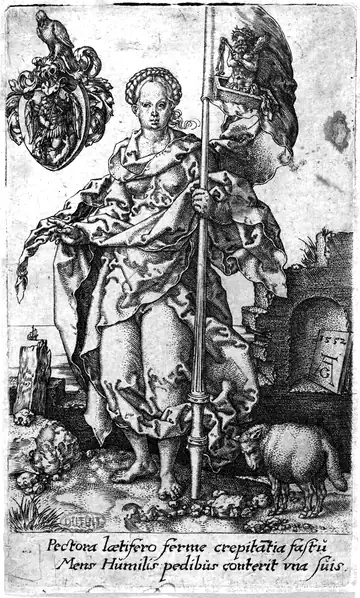
IHumilitas
Humility Answers pride
Seeing yourself accurately, without needing to stand above anyone.
In daily life: hearing that you were wrong and not reaching for a defence.
Answer 21 everyday statements to see which of the seven virtues leads in you. Then set each virtue against its deadly sin.
Your seven deadly sins result is loaded. Finish this test to see both, pair by pair.
Sample pair
SettledHumility clearly leads pride.
The seven heavenly virtues are humility, charity, chastity, kindness, temperance, patience and diligence. Here they are in order, each with what it means and the deadly sin it answers.
The figures come from Heinrich Aldegrever's set of the virtues, engraved in 1552.
IHumilitas
Seeing yourself accurately, without needing to stand above anyone.
In daily life: hearing that you were wrong and not reaching for a defence.
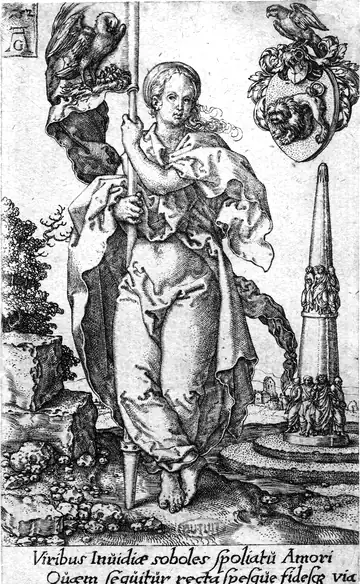
IICaritas
Giving freely, with no ledger running in the background.
In daily life: sharing time or money when nobody will know about it.
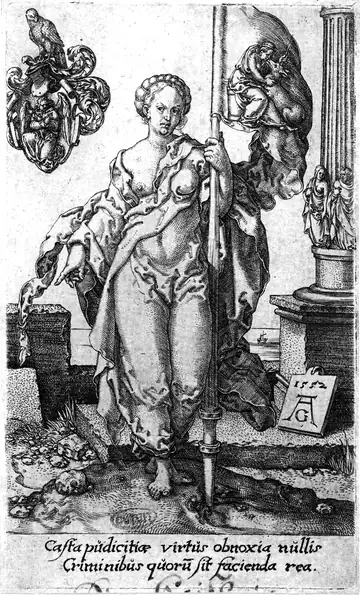
IIICastitas
Wanting without being ruled by it, and keeping faith with what you promised.
In daily life: feeling a strong pull and still acting on your commitments.
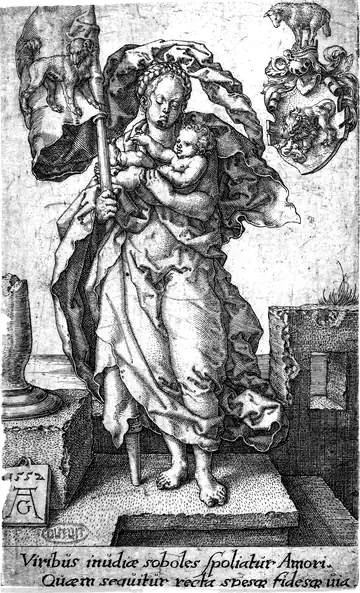
IVHumanitas
Wishing others well and acting on it, including when they are ahead of you.
In daily life: being glad when a rival gets good news.
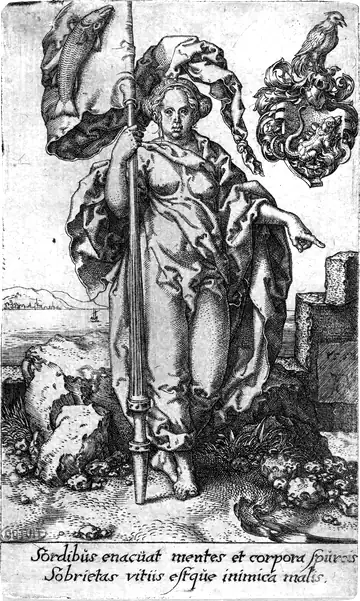
VTemperantia
Enjoying things fully and stopping at enough.
In daily life: closing the app at the point you meant to.
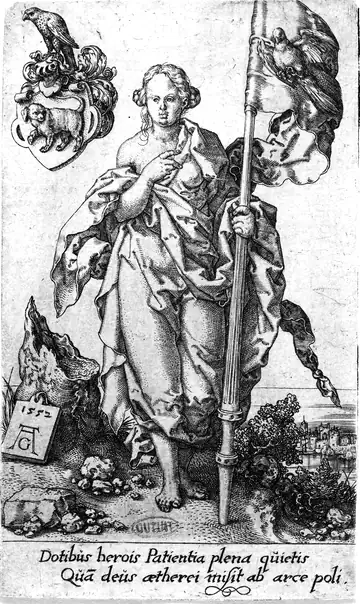
VIPatientia
Staying steady under delay, friction and provocation.
In daily life: waiting before you answer an irritating message.
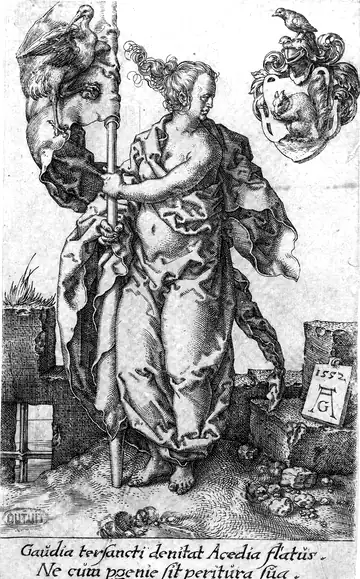
VIIIndustria
Careful, sustained effort on what matters, including the dull parts.
In daily life: finishing the part that stopped being interesting.
Each virtue is traditionally set against one deadly sin. 7 heavenly virtues vs 7 deadly sins, pair by pair
You get seven scores, one for each heavenly virtue: humility, charity, chastity, kindness, temperance, patience and diligence. The highest is named as your leading virtue and shown with its engraving from 1552.
Each score runs from 0 to 100 and stands on its own. The scores are not percentiles and do not add up to 100. A tie is shown as a tie.
This 7 heavenly virtues quiz is a short self-report for reflection. It is not a personality inventory, a diagnosis or a measure of faith.
Choose “Neither agree nor disagree” for all 21 statements and each virtue scores 50 out of 100. All seven tie, so no single virtue takes the lead.
| Virtue | Score |
|---|---|
| Humility | 50 |
| Charity | 50 |
| Chastity | 50 |
| Kindness | 50 |
| Temperance | 50 |
| Patience | 50 |
| Diligence | 50 |
Your virtues result is complete on its own. Adding a sins result for the mirror is optional. See how the scores are calculated.
There are no right answers to learn. For a worked example, see the seven-score sample above; for the formula and limits, read the full scoring method.
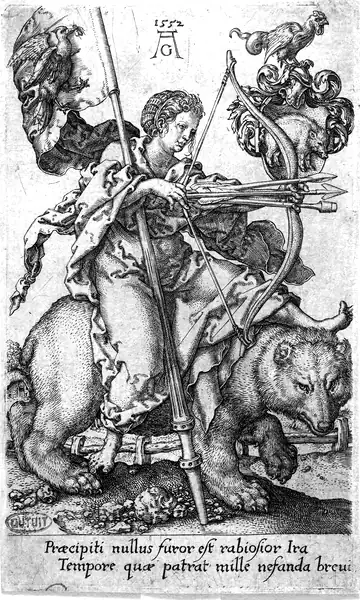
Patience and Wrath, from the two sets of 1552
Every heavenly virtue answers one deadly sin. If you have taken our 7 deadly sins test, paste that result link into your virtues result and both are drawn on one scale: humility beside pride, patience beside wrath.
Sample mirror, three of the seven pairs
SettledPatience clearly leads wrath.
PulledGluttony clearly leads temperance. There is room to move here.
ContestedBoth run strong. The pull of sloth is real, and so is the diligence that answers it.
The mirror marks three pairs for you: the one where you are most settled, the one that pulls both ways, and the one with the most room to move.
Both tests have 21 statements and use the same scoring, so the two sets of numbers can be read side by side.
The pair labels describe these two self-reports; they do not show that one trait causes or cancels the other. Read the scoring limits.
Each virtue has three statements. You answer on a five-point scale from strongly disagree to strongly agree.
One statement for each virtue is reverse-scored, so agreeing with everything does not lift every score. A virtue's score is its points out of 12, shown as a number out of 100.
Your answers are scored in your browser and are not uploaded. This is a questionnaire: it does not ask you to upload files. Progress is kept in session storage for this tab, so you can normally refresh and continue; some browsers also restore closed tabs. Use Clear this tab on a result to remove the saved quiz data.
Sharing is optional. A share link carries seven scores and nothing else unless you choose to include a sins result. You preview it before sending it. Anyone with the link can read or change those scores, so it is not proof of a result. A friend who opens it can take the same test and compare. Visit analytics are separate from your answers; see what is saved and sent.
In the order used here, the seven heavenly virtues are humility, charity, chastity, kindness, temperance, patience and diligence. Each one is traditionally the opposite of a deadly sin, in the same order: pride, greed, lust, envy, gluttony, wrath and sloth. There is no single official order, and other lists start with chastity and end with humility.
Your leading virtue is whichever of the seven scores highest in your answers. Rate the 21 statements and the result names your strongest virtue, then shows all seven scores from 0 to 100 so you can see how close the others are. If two or more tie at the top, the result shows the tie instead of picking one.
You rate 21 everyday statements from strongly disagree to strongly agree. Each virtue has three statements, and one of the three is reverse-scored. The test adds them up and shows seven scores out of 100, with the highest named as your leading virtue.
About three minutes. There are 21 statements and no sign-up. You can pause and carry on later in the same tab.
Yes. Open 7heavenlyvirtues.site in your browser and choose Start the test. The questionnaire, scoring and full results run on the website; there is no app or software to install. JavaScript must be enabled.
The test is browser-based, with tap and click controls and optional number keys 1–5. It is designed for current mobile and desktop browsers, including Safari, Chrome, Firefox and Edge, rather than a Windows, Mac, Linux, Android or iPhone app. Enable JavaScript. If browser storage is blocked, you can still take the test, but refreshing starts it again. If controls do not respond, update your browser or contact support.
There is no daily attempt counter or paid quota in this quiz. To start fresh after a result, choose Clear this tab, then Start the test. A new result reflects the answers you give that time; it is not evidence of a lasting change in character. Ordinary website availability and anti-abuse protections still apply.
Yes. The seven heavenly virtues test is free, with no account, no email and no paid results.
No. It is an original self-report quiz that uses the seven virtues as a frame for reflection. It has not been clinically validated, and it does not measure faith, morality or mental health.
Humility answers pride, charity answers greed, chastity answers lust, kindness answers envy, temperance answers gluttony, patience answers wrath and diligence answers sloth. If you add a result from our 7 deadly sins test, the site draws all seven pairs on one scale.
The list grew over centuries and does not appear as a set in the Bible. Prudentius's late-antique poem Psychomachia depicts personified virtues fighting vices, but not the exact modern list. Pope Gregory I later described seven principal vices beneath pride; his version also differed from today's seven. This test uses the modern contrary virtues, each paired with a deadly sin.
No. That is a different list of seven: prudence, justice, fortitude and temperance, with faith, hope and charity. This test uses the seven virtues that are traditionally set against the deadly sins.
Your answers are scored in your browser, not uploaded. Session storage keeps your progress and answers in this tab so a refresh can normally continue the quiz. If storage is blocked, a refresh starts again. Clear this tab removes the saved quiz data. Optional share links contain summary scores, not your answers or name; visit analytics are explained separately in the privacy policy.
They are engravings by Heinrich Aldegrever, made in 1552 as two sets of seven called The Virtues and The Vices. The images come from the Petit Palais in Paris and are published by Paris Musées under a CC0 public domain dedication.
Neither. This test asks you to rate 21 everyday statements and gives seven self-report scores. It does not grade your knowledge of the virtues or match you to an anime character. You do not need religious knowledge to answer, and the result does not measure faith or moral worth.
On your result, choose Share or Preview my share link, check what it contains, then copy or share it yourself. A friend who opens the link can take the same test and compare the seven scores. Sharing is optional and nothing is sent to friends automatically. Clearing your tab does not revoke a link you have already sent.
There is no right answer to aim for. Pick what sounds most like you this month.